
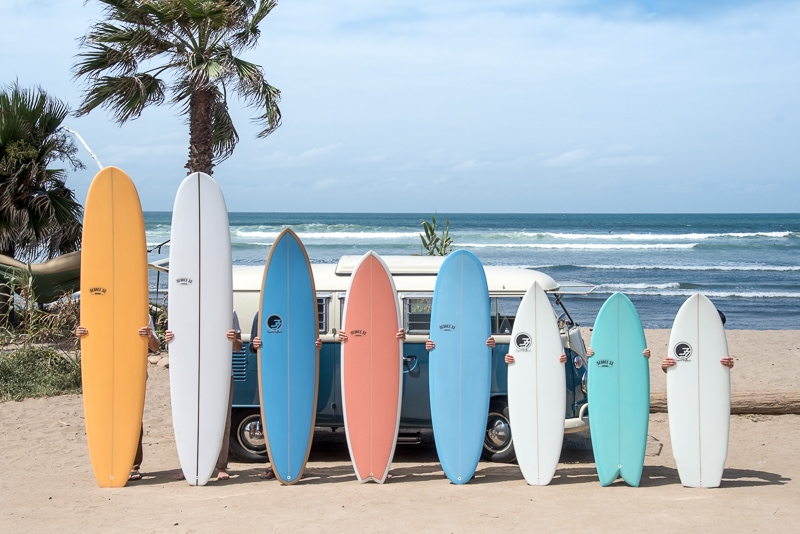
Surfboard Shapes Explained: Finding Your Perfect Wave Riding Tool
Demystify surfboard design with our comprehensive guide to shapes, volumes, and dimensions. Learn how different board characteristics affect performance and which shape suits your surfing style.
Choosing the right surfboard shape can dramatically impact your surfing performance and enjoyment. Understanding how different design elements affect wave riding will help you make informed decisions whether you're buying your first board or adding to your quiver.
Understanding Board Dimensions
Length: Affects paddle power, stability, and maneuverability
- Longer boards: More paddle power, better for small waves, increased stability
- Shorter boards: Greater maneuverability, better for steep waves, quicker turns
Width: Influences stability and paddle efficiency
- Wider boards: More stable, better for beginners, increased paddle power
- Narrower boards: Easier to paddle through waves, better for advanced surfing
Thickness: Determines volume and buoyancy
- Thicker boards: More float, easier paddling, better for lighter surfers
- Thinner boards: Better sensitivity, more responsive, preferred by experienced surfers
Classic Surfboard Shapes
Longboards (8'6" - 12'+)
The traditional surfboard design that dominated surfing for decades. Longboards excel in small, weak waves and offer a classic surfing experience focused on style and flow.
Characteristics:
- High paddle power and wave-catching ability
- Stable platform for beginners
- Traditional surfing maneuvers (cross-stepping, nose riding)
- Excellent for small wave conditions
Best for: Beginners, traditionalists, small wave specialists, older surfers returning to the sport
Shortboards (5'6" - 6'8")
The high-performance boards used by most competitive surfers. Designed for maneuverability and critical wave sections.
Characteristics:
- Maximum maneuverability and responsiveness
- Better for steep, powerful waves
- Requires more skill and experience
- Limited wave-catching ability compared to longer boards
Best for: Intermediate to advanced surfers, powerful wave conditions, progressive surfing
Fish Boards (5'4" - 6'2")
Wide, thick boards with distinctive fish tail designs. Originally created for small wave performance but now used across various conditions.
Characteristics:
- Excellent small wave performance
- Wide template for stability and speed
- Unique feel and surfing experience
- Often ridden as twins or quads
Best for: Small wave enthusiasts, surfers wanting something different, intermediate surfers
Funboards/Mid-Length (6'8" - 8'6")
The versatile middle ground between longboards and shortboards. These boards offer the best of both worlds for many surfers.
Characteristics:
- Good paddle power with decent maneuverability
- Versatile across various wave conditions
- Forgiving for learning advanced maneuvers
- Practical for most recreational surfers
Best for: Intermediate surfers, versatility seekers, most weekend warriors
Volume and Flotation
Board volume (measured in liters) determines how much water the board displaces and directly affects:
- Paddling ease
- Wave-catching ability
- Stability in the water
- How the board feels under your feet
Volume Guidelines by Skill Level:
- Beginner: 0.5-0.8 liters per kg body weight
- Intermediate: 0.35-0.5 liters per kg body weight
- Advanced: 0.25-0.35 liters per kg body weight
Tail Shapes and Performance
Round Tail: Provides hold and control in larger waves, smooth turns Square Tail: Adds stability and drive, popular on performance boards Pin Tail: Maximum hold for big wave surfing, reduces tail area Fish Tail: Creates lift and speed, distinctive feel and appearance Rounded Pin: Versatile option combining hold with maneuverability
Bottom Contours
Flat Bottom: Fast and stable, good for beginners Single Concave: Channels water for speed and lift Double Concave: Separates water flow for maneuverability V-Bottom: Helps with rail-to-rail transitions
Fin Configurations
Single Fin: Traditional setup offering drive and flow Twin Fin: Loose, skatey feel with good speed Thruster (3-fin): Most popular setup balancing drive and maneuverability Quad: Fast and loose, excellent for generating speed 5-Fin: Ultimate versatility allowing multiple setups
Rail Shapes
Soft Rails: Forgiving and stable, good for beginners Hard Rails: More responsive and performance-oriented 50/50 Rails: Balanced option for versatility Tucked Edge: Sharp rail for maximum hold and control
Rocker Profiles
Continuous Rocker: Smooth curve from nose to tail, good for small waves Staged Rocker: Distinct sections optimized for different wave sections Nose Rocker: Prevents pearling in steep waves Tail Rocker: Affects how the board releases from waves
Choosing Your Shape
Consider Your Skill Level
Beginners should prioritize stability and forgiveness over high performance. Advanced surfers can handle more specialized designs.
Assess Your Local Waves
Small, weak waves favor different shapes than powerful, hollow waves. Choose boards suited to your most common conditions.
Define Your Goals
Are you focused on progression, fun, or specific maneuvers? Different shapes excel at different aspects of surfing.
Think About Physicality
Age, fitness level, and surfing frequency should influence your choice. Older or less frequent surfers often benefit from more forgiving shapes.
Building a Quiver
Most dedicated surfers eventually own multiple boards for different conditions:
- Daily driver: Versatile board for most conditions
- Small wave specialist: High-volume board for weak surf
- Step-up board: Larger board for bigger waves
- Fun board: Something different for variety
Testing Before Buying
- Demo programs from surf shops
- Borrowing from friends
- Rental experiences in different conditions
- Professional fitting consultations
Custom vs. Production Boards
Production Boards: More affordable, proven shapes, readily available Custom Boards: Tailored to your specifications, unique designs, higher cost
Remember that the "perfect" surfboard doesn't exist—every design involves compromises. The best board for you balances your skill level, local waves, and personal preferences. Don't be afraid to try different shapes and sizes as you develop as a surfer.
Start with a shape that's forgiving and appropriate for your level, then experiment as you gain experience and better understand your preferences.